🎮 Homepage | 🦋 Bluesky | 👤 About Me
Recently I finally finished Halo Infinite, possibly the longest it has taken me to do so from start to finish. This isn’t immediately criticism (or praise) of the game. Its length is not excessive, nor did it feel too short either, but the change in direction present in Infinite certainly did impact how I engaged with it.
Usually with Halo games, given how they are typically broken up into somewhat distinct levels, I would play at least one or two levels in an evening play session. Part of Infinite’s new approach is its take on an open world and this intentionally alters the player experience in Halo unlike any other (with the closest exception being Halo 3: ODST).
The problem with Infinite is that as a whole, it is not a true open world game. This is especially apparent when considering the beginning and ending [don’t worry no story spoilers] of Infinite from a gameplay perspective. The beginning is not too dissimilar to that of Halo 4, linear with some overarching tutorials thrown in, and it’s a good hour or so until the open world is revealed. The ending of the game sees a further return to the linear style that kicked things off, by the end I almost forget that this was being marketed as “open world Halo”.
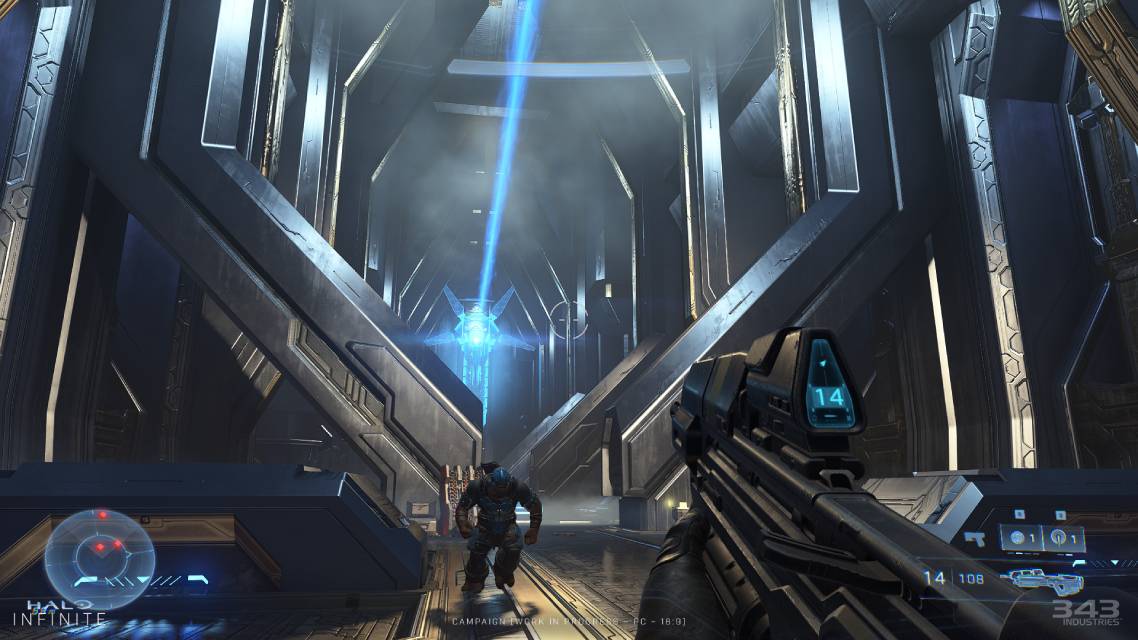
Then again, for the main missions it seemed like the developers (led by 343 Industries) also forgot what kind of game they were making. Some missions took advantage of the wider space, but Halo games are known for their expansive levels. Others though were a collection of different Forerunner constructed corridors and hallways.
The thing is though, if they had just created another Halo game I would have been happy (anecdotally a couple of my friends would be too). I didn’t think there was anything inherently wrong with Halo 5 aside from some repetition towards the end. Linear should not be a dirty word in level design and nor should open world be considered the only way to go instead.
Hope you like Forerunner architecture, especially hallways.
It is here that I can finally introduce the comparison that inspired me to write this entry. As is hopefully given away by the title, that is The Legend of Zelda: Breath of the Wild. This is a videogame that received seemingly universal praise, from its art style, gameplay, and environment.
Whilst I agree that BotW is a very accomplished videogame, as a Zelda game, I found it sacrificed too much, yet I respect it for doing something different and sticking to it. Zelda games have often been recognisable for their dungeons and bosses, but BotW is not as concerned with these as its predecessors. Not that dungeons are afterthoughts (some of the puzzles are series highs), but it created a visual problem that Infinite also suffers from.
With previous Zelda games, each dungeon was unique, yes there have been multiple forest, water, fire dungeons (often duplicates within a game) but the visual design meant that within an individual entry one could visually distinguish the different dungeons based on the style alone. The same cannot be said for BotW as each of the four different divine beasts share the exact same look. The architecture might be different but if you were shown a generic screenshot from each at random you would be hard-pressed to instantly know which dungeon it came from. This is exacerbated by the inclusion of the 120 shrines hidden all over Hyrule. The majority of these in terms of what the player has to do is remarkable in its variety, but share the same issue as the divine beasts as these too have a very similar visual style. When you see the same background upwards of 50 times (let alone 120) then repetitive is just one word for it.
/cdn.vox-cdn.com/uploads/chorus_asset/file/8165113/Terminal_1_5.jpg)
Quick, guess which Devine Beast this is from.
However, I get why this is the case, it is ridiculous to expect Nintendo to create a different style for each of the different shrines, or even for the different type of shrines. Then again, whilst I understand why this same rationale was applied to the divine beasts I still wish there was more that could have been done to distinguish between them. Even if it was the bosses, which are the most forgettable in the whole series.
This brings us back to Halo Infinite. What both these individual games share is an open world for the player to explore in between, to experiment with the mechanics. To create a believable or fleshed out world takes a lot of effort and resources, which is why other areas become more economical in design.
BotW benefits the most from this, whilst there are side quests, the open nature of Hyrule in this instance feels truly open, that you the player are on an epic journey from one location to another yet unknown. Infinite’s overworld feels like just one part of a halo ring, like you are arbitrarily restrained to that area. Then to help mask this are special targets to take out and bases to capture as well as a sprinkling of items to collect.
Sure, it acts as a somewhat entertaining distraction, helped by the fact Infinite has the best feeling movement and shooting it’s ever had (and Halo games have always felt good to play), so it doesn’t necessarily feel like a waste of time, even if it might seem like an excuse for padding out the campaign. Halo campaigns have never actually been particularly long, a good length to tell its story and provide memorable gameplay, but not long enough to outstay its welcome.
Infinite does use its open world to hide pieces of lore in the form of audio logs and then there are the Spartan cores needed to level up Master Chief’s other abilities. Aside from that, there isn’t much incentive to explore and I would understand if a player does just want to go through the main missions without taking a break in the wild.
BotW might have nods and references to its past and could be argued to be a true realisation of the very first Zelda game, but it does manage to do something to truly distinguish itself from previous 3D Zelda games. Infinite on the other hand can’t decide if it wants to break the formula by going “open world” or be another Halo game due to its relatively linear missions interrupted by conversations from an AI. That confusion lingers in the back of the mind, especially by the end. Whilst it could have been worse, given that somehow the two sides of the game aren’t at odds with one another, but this is still a game of two halves. Trying to do something different, but without the confidence or ability to let go of its past.
UPDATE: Reflections from 03/02/22
Click below to read my follow up to this post.
Reflections considering “newness” and “novelty” in the context of Infinite and Breath of the Wild